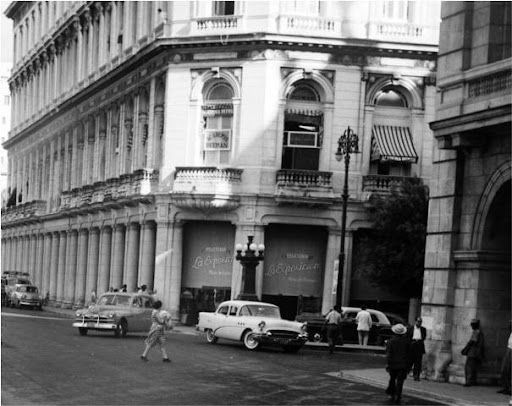
Hola! I don’t usually post short stories here, but today I feel like sharing the English translation of “El día que volvía a ayer” (The Day I Returned to Yesterday) because of its connection to The Novel Detective. Just like the novel, the plot takes place in the Manzana de Gómez building and, at least the first part, during the time I was a student there, from 1977 to 1980.
Ever since those days, I wanted to write about La Manzana. This short story was my first attempt. Maybe that’s why it’s still very close to my heart… It has been published in Spanish in several places online and is part of the collection En la Feria del Libro de Miami y otros viajes astrales, reviewed here by Professor Marisela Fleites-Lear.
I hope you enjoy my little story… And who knows, maybe one of my readers has also traveled back in time!
The Day I Returned to Yesterday
Most of my middle school classmates fell platonically in love with movie stars, athletes, and singers. In Cuba, we called it being metidos—literally “stuck” on them—though, at least in theory, nothing material was inserted anywhere. Among the stars from across the Atlantic, Alain Delon shone the brightest. It was the late seventies, and Luisita Fraga had plastered a massive poster of the French actor on her bedroom wall, lighting a candle to him every day as if he were a deceased relative.
“Estúpida, you’re going to burn the house down with this nonsense,” her grandmother grumbled, but Luisita never wavered in her daily devotions.
My next-door neighbor, Isela, was obsessed with The Beatles. Since she couldn’t pick just one, she rotated through a different Beatle every month. Other girls chose local objects of desire. Take Alfredito Rodríguez—he appeared on TV in a sharp suit and tie, singing romantic ballads that bordered on rebellious in an era that otherwise celebrated sweaty singers and a rhythm called Mozambique. Girls swooned.
Then, a 1979 re-release of the 1948 Hollywood comedy Abbott and Costello Meet Frankenstein sparked a sudden vampire craze. It was a scaled-down, Cuban version of what Twilight would later unleash on the world. Girls began sighing over the pale masculinity of Count Dracula, and even Lon Chaney’s Wolf Man gathered a few fans. Another friend, Yarmila, idolized Béla Lugosi, likely oblivious to the fact that he had died in ’56, a decade before his Cuban fan was even born. Yarmila was the first in our group to “develop” (another euphemism of the era) and deemed it appropriate to show us all her sanitary pad, stained with a reddish, pungent liquid.
As for me, the oddball? I wasn’t interested in unreachable stars. My crushes, though no less platonic, were on ordinary, flesh-and-blood guys. One of my earliest meteduras was into the dialectical abyss of a ninth-grade Marxism teacher nicknamed Quique. Despite the mind-numbing boredom of his subject—or perhaps because of it—I spent his classes daydreaming. I visualized myself as an adult: taller, more confident, wearing a white dress like Claudia Cardinale’s in The Leopard instead of my usual white and mustard uniform. This grown up, imagined version of me had returned to our middle school for a sweeping, happy-ending kiss with Quique…
I was so obsessed that one day, while staring into the empty hallway as his voice droned on, I thought I saw her. My adult self, standing just outside the classroom door, peering inside. The upgraded Teresita wore fabulous sunglasses perched stylishly on her head. The real Teresita, however, was afflicted with a vicious case of nearsightedness. Forced to wear eyeglasses with thick plastic frames, I earned the lovely nicknames Little Owl and Four-Eyes. To top it off, the glasses didn’t even help. Due to poor-quality lenses or a bad prescription, I blundered through life half-blind.
Our school occupied the fourth floor of a battered old building: La Manzana de Gómez, located right across from Central Park. Climbing its marble staircase was a daily ordeal for my myopic self. On good days, it meant a slip; on bad days, I fell flat on my butt and slid down to the next landing. Luckily, I befriended Lázaro, the kind elevator operator. He took pity on me and spared me the agony of the stairs, smuggling me into the creaking Otis elevator that had been in the building since the fifties, or earlier, even though students were strictly forbidden from using it.
On the ground floor of La Manzana were clothing stores, a shoe shop, and La Central, the pharmacy where my mother worked. She would come upstairs during recess to bring me a sandwich, triggering endless teasing from my classmates. Between the hideous glasses and my mother’s helicopter visits, I spent my teenage years to a soundtrack of snickers. But who cared? The snack was essential. I was scrawny and desperately needed to “develop.”
Quique wasn’t exactly a male model either. Short, skinny, and verging on ugly, he was a gawky guy with military-short hair that was already thinning. When I confessed my crush to Luisita, she burst out laughing.
“Girl, that prof is uglier than a wood sandal,” she said. “And look at his head… he’s going to be balder than a baby’s bottom in a few years!”
To complete the picture, Quique wore blue plaid shirts that were the epitome of cheísmo—Cuban slang for the ultimate in bad taste. Of all the ninth-grade girls, I was the only one who found him sexy, or even desirable. But love is blind, or at least as nearsighted as I was.
While Quique lectured about the correspondence between the productive forces and the relations of production, I imagined the two of us strolling arm in arm down the school’s long hallways. Those halls were always heavy with the smell of urine wafting from the bathrooms, whose wooden doors had been chewed up by years of humidity.
I never managed to make my daydreams come true. Maybe Quique considered me his best student—I tried hard to get the highest grades on the exams just so he’d notice me—but I’m sure he never realized I secretly adored him with the same passion Luisita felt for Delon and Yarmila for Lugosi. And if he did notice, it didn’t matter to him one bit.
I don’t blame him, really. Besides being shy, bony, and four-eyed, I was also woefully lacking in the backside department. This absence of a hallmark of Cuban charm put me at a serious disadvantage when it came to attracting male attention. I never had a boyfriend. I never had a boy with whom to sneak off for kisses on the stairwell landings we called the tunnels of love.
And so my ninth-grade year at José Antonio Echeverría Middle School drifted by: hopelessly crushing on Quique and longing for some distant, blurry tomorrow when I would no longer be skinny and shy. A tomorrow when I would return, dressed in white and without glasses, to seek out my old teacher. He would be frozen in time, still giving his Marxism lectures… waiting for me.
Fifteen years later, in 1995, Havana was struggling through the Special Period. It was a surreal time when buses turned into eighteen-wheel trucks called “camels” and sanitary pads became scraps of cloth. Beef mutated into a concoction known as goose paste, though it contained no goose, or any other poultry. The lack of vitamins turned us paler than Lugosi’s Dracula. The movie theaters went dark; there was no electricity for Abbott, Costello, Delon, or anyone else.
Yarmila, who had become a nurse, treated too many neuropathy cases at the Hermanos Ameijeiras Hospital. Back then, we talked constantly about “solving problems.” Among the problems to solve were breakfast, lunch, and dinner. It was impossible to find soap, chicken, shoes, or cooking oil. To buy them, we needed dollars. The Cuban peso had lost what Quique would have called its exchange value, and illegal foreign currency began to dictate the correspondence between the productive forces and the relations of production.
I had solved my own Special Period problem in a very pragmatic way: by marrying an American. With a plane ticket to San Diego in my pocket, my time on the island was coming to a close. It was late December, and unusually cold. By then, I had shed the thick-framed glasses for contact lenses. I now looked out at the world through a pair of flirty, purple Persol sunglasses.
I was less shy than in my teenage days, though still short, skinny, and, let’s be honest, not yet particularly blessed in the backside department. Upon arriving in the United States, I would learn that big butts didn’t drive American men crazy, a fact I happily documented in my story The Astral Portrait, but back in Cuba, my lack of assets left me at a disadvantage. Now, the fact that I had married a foreigner made both my friends and enemies turn green with envy.
As Luisita, who had graduated with a degree in French, put it: “God gives a beard to those who have no chin.” Yarmila was even more graphic, swapping beard for husband and chin for butt.
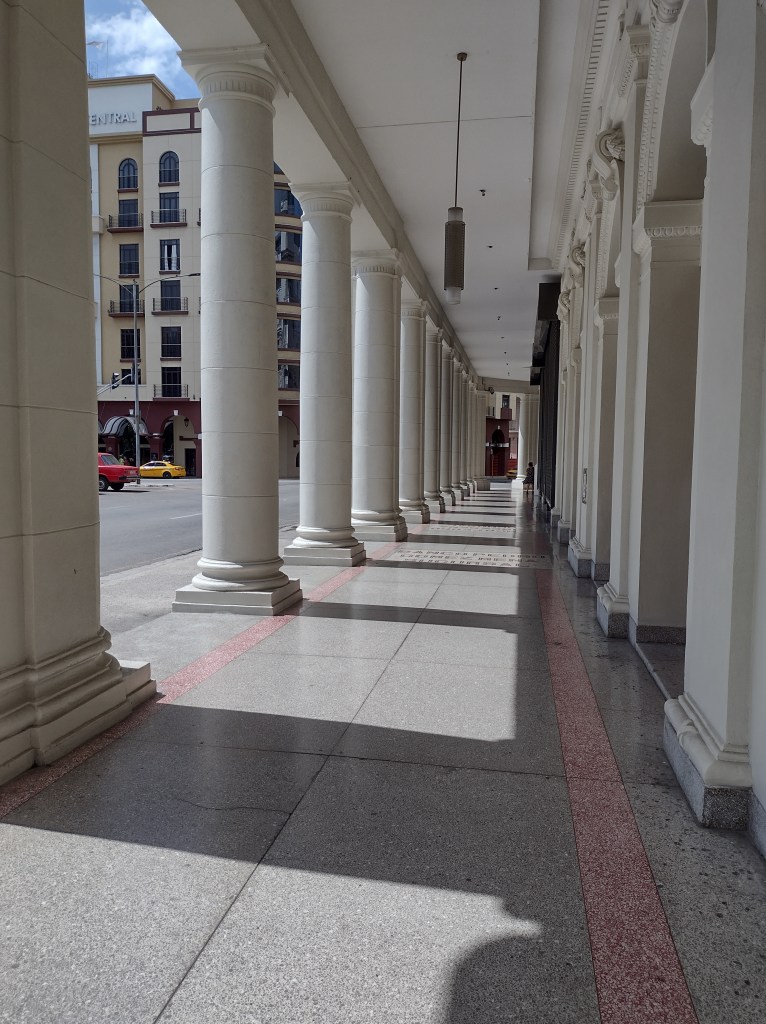
The José Antonio Echeverría Middle School was long gone. On the ground floor of La Manzana de Gómez, only two stores remained open, along with a small café that was always empty because hot dogs and sandwiches had to be paid for in dollars. It catered mostly to the few tourists who, like my husband, wanted to take a last look at Cuba “before it changed for good.” The upper floors of the building were completely abandoned.
I hadn’t set foot in La Manzana in years. But when Isela asked me to accompany her to buy a flashlight—a necessity during the frequent blackouts—at one of the surviving stores, I said yes without thinking twice. I’m not sure why I did. I’ve never been sentimental, and my memories of middle school weren’t particularly sweet. Maybe it was the chill of that winter afternoon, maybe boredom, or maybe the quiet certainty that I would soon be leaving Havana behind, and who knew for how long.
As we walked away from the building where we both lived, she asked me, all of a sudden, “Would you rather live in tomorrow or yesterday?”
At that point, our tomorrows were looking rather bleak. People remembered fondly the years when they could buy a meringue cake without the ration card, or eat a grilled snapper at El Emperador paying with pesos, both things impossible in the nineties. In those rough years, all yesterdays seemed better. But no one knew what the future might bring. It could be worse.
“Tomorrow,” I said without hesitation. After all, my tomorrows were no longer in Havana, but in that distant California city with a very Spanish name: San Diego.
After waiting in vain for a bus that never came, we set off on foot. From where we lived, next to the Emergency Hospital, all the way to Old Havana, it was a marathon of a walk.
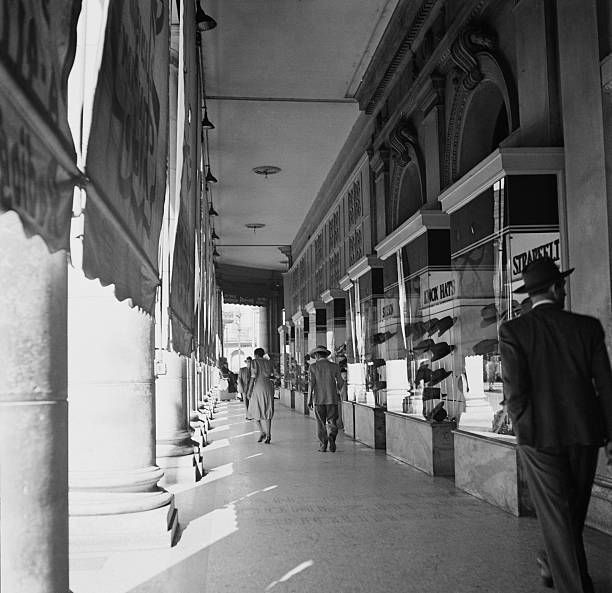
We arrived at La Manzana sweaty and out of breath. Isela took her place at the end of a line that snaked like a giant serpent around La Manzana’s porticoed ground floor. Dozens of people leaned against the arcade columns, waiting their turn. Figuring she wouldn’t get inside for at least an hour, I decided to go upstairs and snoop around. Even today, I can’t explain the sudden urge to see, perhaps for the last time, the classrooms and hallways of my youth.
I pushed my sunglasses up onto my head like a headband—looking quite chic, rather than stashing them in my bag where nobody could admire them— and climbed the stairs, now free of my old fear of tripping. Lázaro was gone; the Otis elevator had been shut down for lack of spare parts. On a landing, a security guard sat filing her nails, too busy to notice me.
The place was eerily silent. I wandered through the deserted fourth floor. Not even the bathrooms smelled anymore as they had been all sealed off. A film of dead insects carpeted the steps leading to the tunnels of love. Though it was just past noon, everything was cloaked in gloom. A dusty haze floated in the air.
It was the perfect set for a Lugosi movie.
A murmur of voices came from a corner. I followed it and found myself in front of a classroom packed with students in white and mustard uniforms. In the front row sat a teenage girl wearing thick-framed glasses, gnawing on a pencil. Her eyes were fixed on the teacher—a gawky guy with thinning, military-short hair. There was something about him, and about the girl, that struck me with a disturbing familiarity.
But those people couldn’t be who I thought they were. First, because the school no longer existed. Second, because after fifteen years, my former teacher had surely changed, or at least updated his wardrobe. And there he was, wearing one of those blue plaid shirts that had disappeared with the arrival of the Special Period. No, that man couldn’t be Quique. That teenage girl with the thick glasses couldn’t be me.
And yet, it was.
I stumbled back, leaning against the wall and rubbing my eyes, nearly dislodging my left contact lens. I was shaking all over under my white dress, which, I suddenly realized, looked a little like Claudia Cardinale’s dress in The Leopard.
Then it occurred to me: why not seize the moment? This was magic in the times of hunger, my chance to fulfill an old, cherished dream. I took a step toward the classroom, then stopped halfway to get a better look at the object of my teenage obsession. Oh, but he was so scrawny and ugly and pitifully sad! I slid the sunglasses down over my eyes, but the dark lenses didn’t do Quique any favors. They only made him seem thinner and more pathetic.
The spell of that old love shattered right between two sentences about the productive forces and the relations of production. I turned and bolted toward the stairs.
As I ran, the hallways began to fill. In a tunnel of love, I caught sight of Luisita hugging Alain Delon, who looked exactly like the poster on her bedroom wall. Farther down, outside the sealed bathroom, Dracula was biting Yarmila’s neck. Yarmila, eyes closed, sighed in blissful surrender. Isela was there, too, kissing every single Beatle, from John to Ringo.
Girls swarmed Alfredito Rodríguez. In fact, a whole parade of long-haired Alfredito clones had sprung up out of nowhere, choking the hallways that had been empty a minute earlier.
I screamed, shoving and kicking my way through that tropical nightmare of ghosts. I shot past the security guard, who finally looked up and barked, “Hey, comrade, where do you think you’re going?”
But I kept running until I hit the ground floor, gasping and wild-haired. After catching my breath, I walked slowly through the darkened arcades, my blood pounding like a Mozambique drumbeat against my temples. The shops were shuttered, the line had vanished, and Isela was nowhere to be found.
Streetlamps flickered on over Central Park. It was seven p.m. My internal clock insisted I’d been upstairs for fifteen minutes at the most, but reality disagreed. Over six hours had vanished. I found a public phone and called Isela. She was frantic, furious, and rightfully so. After hours of waiting, she had finally given up and gone home.
“The store was out of flashlights by two-thirty,” she yelled. “But what the hell happened to you? Where were you?”
I don’t remember my excuse, or if I said anything at all. I just remember hanging up, walking back to Central Park, and sinking onto a bench. Eventually, a camel of a bus lurched up, huffing and belching smoke from its exhaust. Transportation solved. I closed my eyes behind my Persol sunglasses, melted into the sweaty, compact mass of passengers, and didn’t look out the window again until we hit the Emergency Hospital stop. I had taken the trip so many times I could tell where we were by instinct.
I climbed the stairs to my apartment in silence and closed the door on yesterday.


[…] considered myself a realist. Though I’ve occasionally played around with fantasy, as I did in The Day I Returned to Yesterday, there’s always some doubt as to whether everything that happens is just the product of the […]