Review and blurbs
First, I am so happy and thankful for the blurbs I’ve received, soon to appear in promotions for The Novel Detective, and a Publishers Weekly review that left me blushing with delight:
“With lovable characters, a gripping core mystery, and a vividly rendered setting, this bolsters Dovalpage’s reputation as a reliable purveyor of quality crime fiction. Readers will be entertained.”
The description of the characters as “lovable” made my day. Because something I set out to do (besides writing an entertaining novel, of course) was to recover the innocence of those years, both in Teresita and in her classmates. This isn’t euphoric recall or the idea that cualquier tiempo passado fue mejor, as we say in Spanish —literally, any past time was better. I don’t think teenage years are the best time for almost anyone. It’s a period of insecurity, searching and stumbling along. But I did enjoy that journey back in time, which allowed me, in a way, to rewrite the story within the bounds of a fictional plot.
La Manzana from the Inside
When I think La Manzana from the inside, the first thing that comes to mind is the elevator and Lázaro, its old kind operator:
The elevator was a creaking Otis, built in the 1940s, with a cage that smelled of rancid oil. Though it was reserved for teachers and staff, Teresita rode it every day. Her mother had explained to the operator, Lázaro, that the girl’s flat feet prevented her from climbing the stairs properly. Irma complained about the preferential treatment, but kind Lázaro always welcomed Teresita in.
The flat feet and the preferential treatment were real; so was the grumbling teacher.
Fantasies
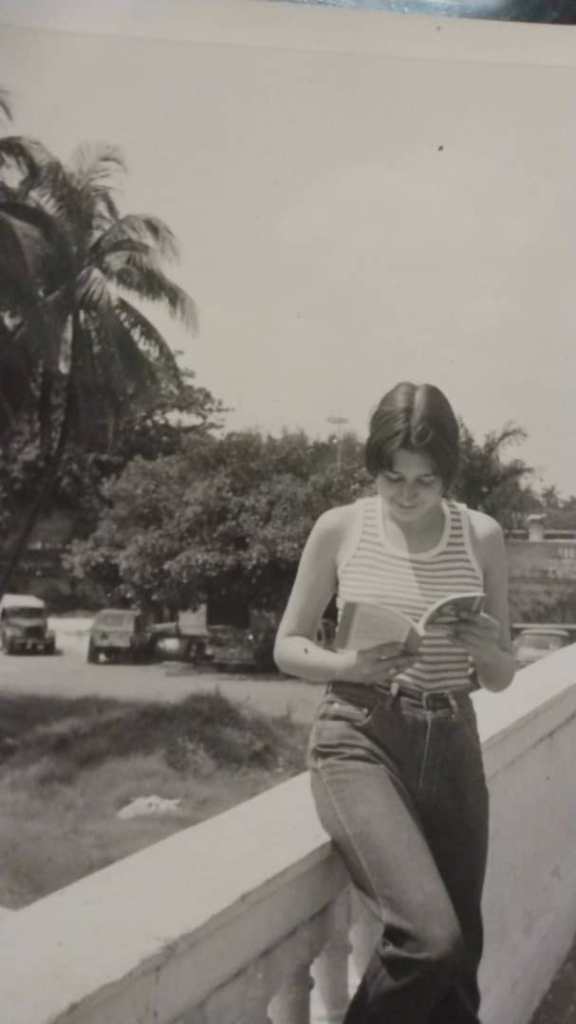
And what did Teresita (the person, not the character) think while riding that elevator every day? When I try now to step back into her mind, my mind back then, I find a tremendous jumble, un batiburrillo tremendo. I was a nervous teenager with an overactive imagination who came up with all sorts of ideas (outlandish ideas, as Topeo would have said) but lacked the courage to carry them out.
Gracias a Dios for that.
I imagined, for example, sneaking into the school library and stealing a book. I even had the plan worked out in detail: how I would distract the librarian, how I would hide the chosen book in my woven bag, and how I would walk out with the most innocent expression in the world.

The funny thing is, there was no need to steal any book: all I had to do was check it out, and I’d had a library card since seventh grade. The librarian liked me, perhaps because I was one of the few students who frequented her usually deserted workspace, and she would have renewed my loan for as long as needed. But somehow, imagining myself as a book thief made me feel daring, special.
Another fantasy, one that inspired the short story El día que volví a ayer, involved Quique, our Marxism teacher. Like the protagonist, I had fallen into a platonic love with him, and while the guy lectured us on productive forces and relations of production, I would drift into imagining a romance more chaste than heated, with the two of us walking hand in hand through the dusty school halls…
Once, Quique left behind in the classroom a book on his subject, written by someone named Konstantinov. I took it home and pored over it devotedly until the next day, imagining Quique’s hands on the book… and perhaps on me.
Now that I think about it, most of my thoughts and fantasies back then revolved around books. What a coincidence.
The Books of La Manzana
At La Central, the pharmacy where my mother worked, there was a storage room that jutted out over the downstairs shopping arcade. Teresita (the character and the real me) used to sit there to snoop. It was the perfect place to see without being seen.
Near the storage room was a shelf of books where I found a copy of Pequeñas maniobras by Virgilio Piñera, a novel titled La danza bajo la cuchilla de la guillotina (whose author I cannot remember and have never been able to locate), and Pedrín by Anatole France, which introduced me to this brilliant man’s work, an influence I still feel today.
From that shelf, I took Pedrín and Pequeñas maniobras. I regret not doing the same with the book on the French Revolution, because when the building was remodeled, I’m sure everything left behind ended up in the trash.
So let this post stand as both apology and public confession: I do not regret one bit the books I actually stole.