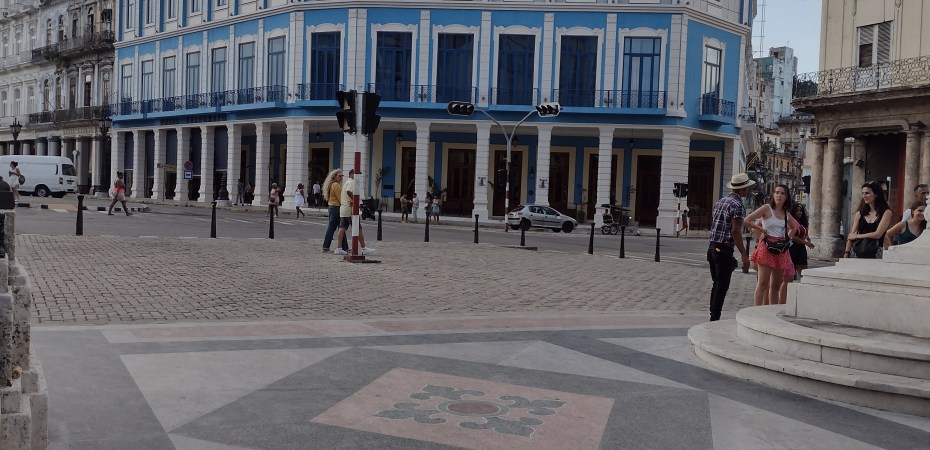
Over the next few weeks, I’ll be sharing a series of short posts about La Manzana de Gómez, Old Havana, and the places where The Novel Detective happens. Some of these places still exist, others have changed considerably, like La Manzana itself, and a few survive only in memory, but all of them are key to understanding the atmosphere of the novel.
So, por favor, come and walk with me through the streets of Old Havana and into the nooks and crannies of…
La Manzana
Like my character Teresita, I attended José Antonio Echeverría Middle School in La Manzana de Gómez. I spent three years there and my mother worked in La Central, a pharmacy located on the ground floor, so I got to know the place like the back of my hand.
Manzana, by the way, means both “block” and “apple” in Spanish. In this case, it refers to an entire block. One of its streets, Zulueta, faces Parque Central, the heart of Old Havana.
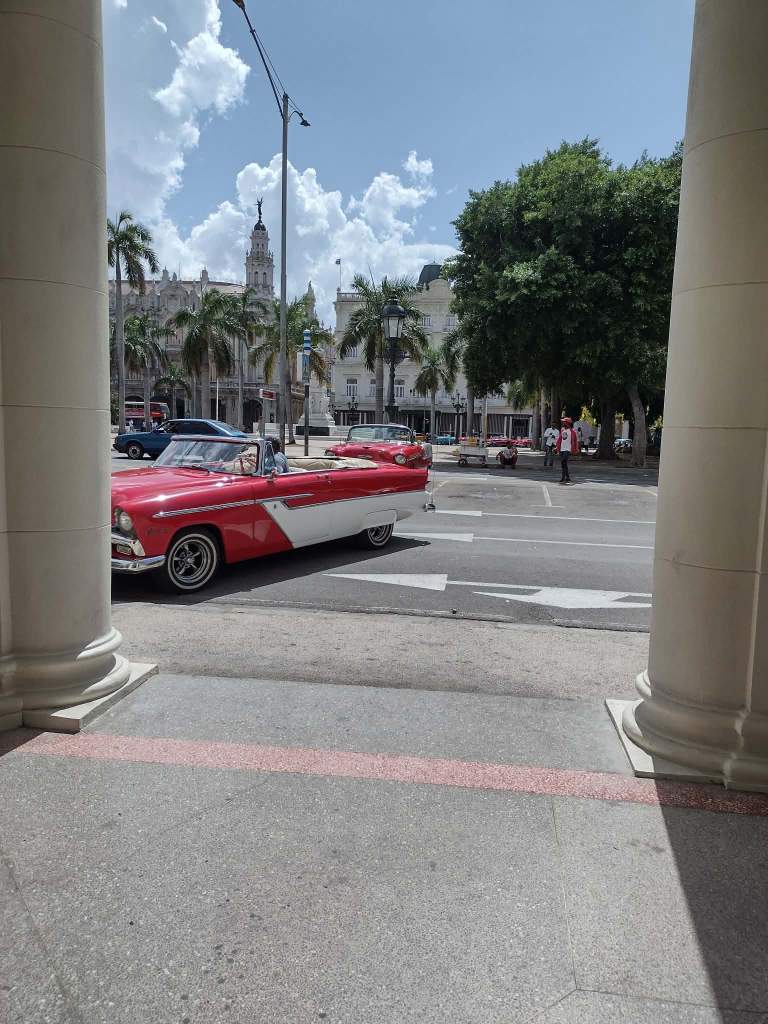
La Manzana boasts a remarkable pedigree: it was one of the first covered shopping centers not only in Cuba, but in all of Latin America. It was also the first block in Havana entirely devoted to commercial use. This is how I describe it in the novel:
La Manzana de Gómez … occupied an entire block, sprawling across Zulueta, Neptuno, Monserrate and San Rafael Streets. (…) In the ’40s and ’50s, the porticoed first floor had housed clothing stores, cafeterias, boutiques and theaters. Some businesses were in the shopping arcade that faced Parque Central. Others occupied the interior passageways that crossed the building diagonally.
When I studied there, from 1977 to 1980, the building was run-down, with many closed off sections and dusty corridors, but it still retained the charm of its imposing columns, high ceilings and granite floors. There were some short flights of stairs called tunnels of love, where a lot of making out happened.
The place also had the spectral allure of a ghost that several classmates swore they had seen:
The building’s first owner, Andrés Gómez Mena, had been shot there in 1917 by the Catalan watchmaker Fernando Reugart. According to rumors, the reason was that Gómez Mena had made an indecent proposition to Señor Reugart’s wife. (…) On the highest floor, which nobody ventured up to, dust and darkness reigned supreme, Gómez Mena’s ghost was said to haunt the deserted corridors, weeping over his property’s fate.
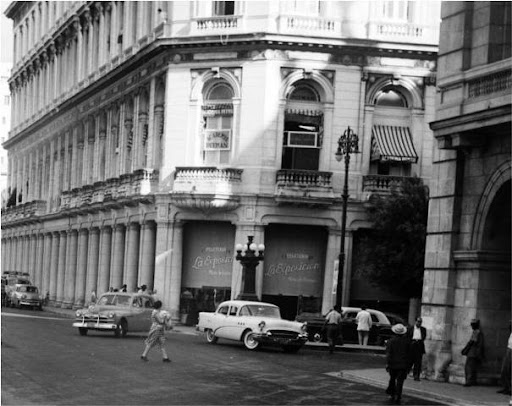
La Central
I started visiting the pharmacy when my mother got a job there as the Technical Director in the early 70s. All the details I give about the place are absolutely true:
The pharmacy La Central had an unusual attraction in the lobby: an aquarium where red and orange fish swam morosely. The aquarium could be seen from the street and passersby stopped to gaze at it. Whenever she came in, Teresita always spent a good five minutes mesmerized by the underwater world and the rhythmic movement of its inhabitants. Then she went up a red spiral staircase to a mezzanine shared by the dispensary, the packaging area and her mother’s office.
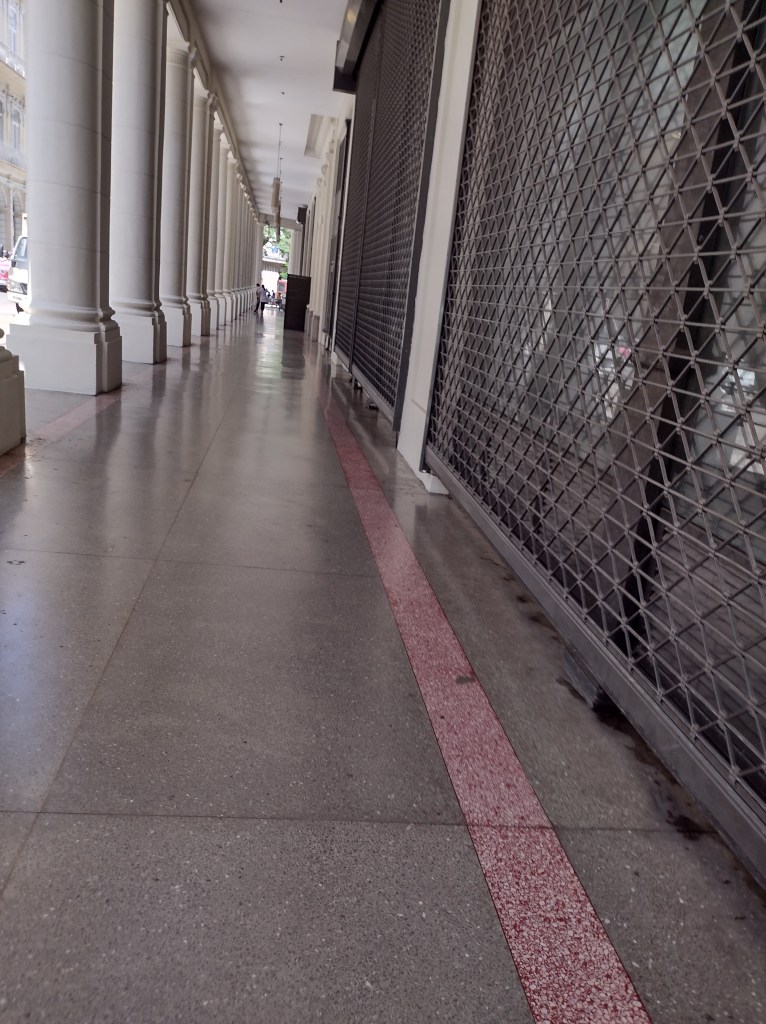
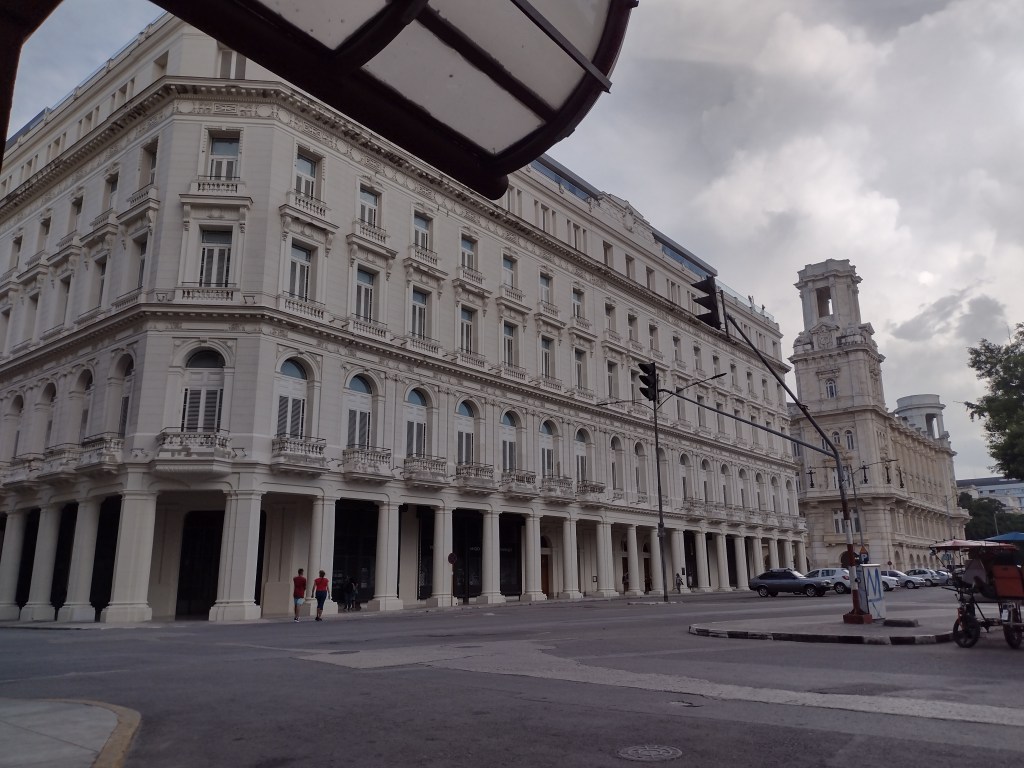
Today the pharmacy no longer exists, and the building has been transformed into a luxury hotel, the Gran Hotel Manzana Kempinski. And that’s where Teresita, now Teresa and with fifty-something years on her shoulders, returns, to uncover a crime she (sort of) witnessed in 1980, and whose memory has haunted her ever since.
When Teresa comes back in 2020, she is amazed at the building’s new incarnation:
The facade had been painted white, making the entire structure appear even bigger and more imposing. Golden light poured from its windows. The porticoed ground floor gleamed. I stared in disbelief, trying to reconcile this sight with the worn gray hulk I had returned to so many times in dreams. It now stood polished, clean— and still very much alive.
The pulse of the stone
The idea that the building itself is alive appears several times throughout the story. Though a metaphor, it is also based on my memories.
Teresita, who had a way-too-active imagination, thought that La Manzana had a life of its own. The building was like a half-asleep giant, lethargic but not dead. A living being that could wake up at any moment and swallow the students running through its halls and the teachers lecturing in the classrooms . . .
Maybe I had an active imagination too. Often, while walking through the school corridors, I remember feeling a breath, a presence that did not belong to this world. Just like my character, I came to think that the place had a life of its own, a consciousness… and not exactly the best intentions in the world.
But I’ll talk about that in the next post, La Manzana from the Inside.
 Teresa Dovalpage: a Cuban writer's blog
