
Originally published in The Taos News
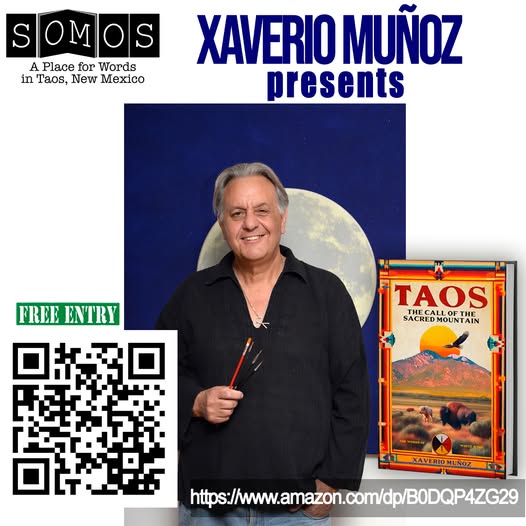
On Saturday, July 12, SOMOS hosted the presentation of Taos: The Call of the Sacred Mountain, a book by Spanish artist Xaverio Muñoz, who has made Taos a source of inspiration.
A painter, sculptor, writer, and self-taught researcher, Muñoz defines himself more by his curiosity and desire to share well-being than by traditional labels. “I’m a simple person with a desire to learn,” he said. “I try to feel good, and I want those around me to feel good too.”
His philosophy of life is reflected in his visual and literary work, and also in his therapeutic method, the Indalo Codex, which he developed in Taos and focuses on personal growth and holistic healing. His techniques have helped people with respiratory allergies, insomnia, and other ailments, Muñoz said. He has shared them in workshops around Taos, including the most recent one at Mabel Dodge Luhan House on July 3.
The call of Taos
Muñoz’s connection to Taos began in 1998, when he was invited by artist KC Tebbutt, director of Untitled Fine Art gallery, to paint and exhibit in the area. He arrived through a series of coincidences that included exhibitions in Denmark and Santa Fe—but for him, the deeper explanation lay elsewhere.
“From an esoteric perspective, it is the Taos mountain that calls those it wishes to receive,” he said.
That spiritual calling is at the center of Taos: The Call of the Sacred Mountain, a work that weaves together poems, stories and ancestral wisdom through the voice of a visionary character, Viento Blanco (White Wind).
“One day, an Indian shaman named White Wind appeared in my mind,” Muñoz said. “He said he belonged to a great tribe called Humanity and began dictating his words of wisdom to me.”
The book explores themes ranging from Indigenous rituals to cosmic evolution and the awakening of human consciousness. As for White Wind’s message, it is both poetic and urgent: “May the smoke of this pipe rising to the sky bring peace to this land and to the entire world. Let us act as brothers who love one another and are kind, and let joy reign in our hearts.”
Another character featured in the book is Juanita, a healer from Questa inspired by a real woman whom Muñoz met through his friend Tanya Vigil many years ago.
“I went to her for a herpes outbreak, and she healed it using cornstarch and vitamin A-rich oil,” he said. “She told me, ‘Xaverio, you have the gift of healing, and if you don’t use it, it will turn against you.’”
That encounter motivated him to delve deeper into therapeutic research and, ultimately, to develop the Indalo Codex. It is just one of the many ways in which Taos has influenced Muñoz’s life and work.
“Taos is a place where consciousness rises,” he said. “That’s why it’s so important for artists and writers… and for anyone who feels the mountain’s call.”
The reading
During the event at SOMOS, Vigil read the poems in English while Muñoz shared them in Spanish, creating a poetic dialogue that engaged the audience, made up of people who spoke English, Spanish or both.
“In these times of uncertainty, I believe this book is more relevant than ever,” Vigil said. “As Viento Blanco says, what is happening now in the world resonates deeply within its pages. I feel that Taos Mountain has a powerful message for us: it helps us awaken our consciousness and find clarity amidst the chaos.”
Audience member Michael Knight added: “Xaverio shares White Wind’s timely vision of current human conditions, the challenges we face in these turbulent times, and an admonition to pursue peace and harmony in order to achieve higher consciousness.”
Images of the soul… and of artificial intelligence
The book contains images created with the help of artificial intelligence in an artistic experiment that, though quite controversial, explores the interaction between word, image and technology.
“Artificial intelligence is a human creation that learns continuously,” Muñoz said. “It can be a powerful tool if used for the good of humanity, but we must continue to use our own minds and hands to remain independent, active and creative.”
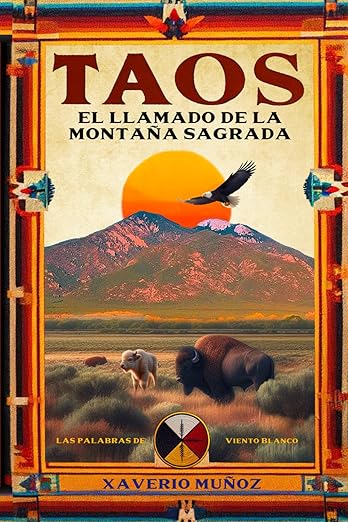
Taos: The Call of the Sacred Mountain is available on Amazon.
 Teresa Dovalpage: a Cuban writer's blog