How I used the amazing Andrew McGregor’s deck in my novel
Ah, the Tarot mysteries! The archetypes that guide us in our journeys, the wisdom kept in ancient images and symbols…
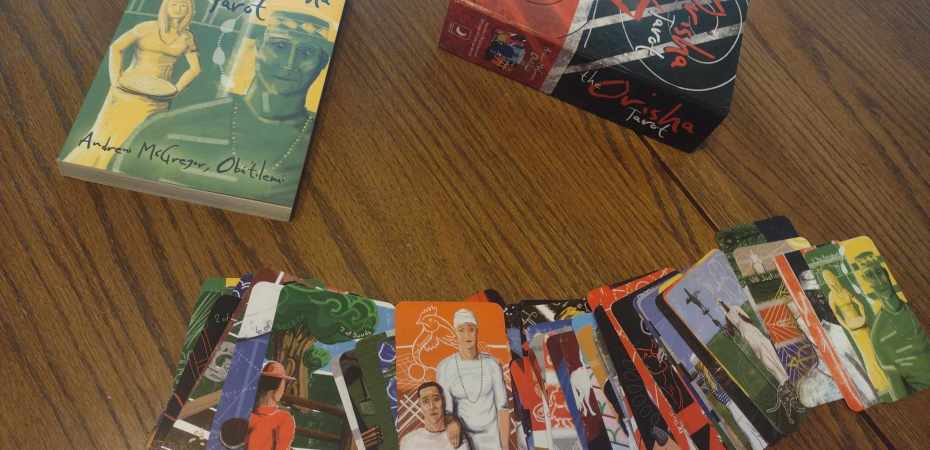
I got my first Tarot deck in Taos, at Nyna Matysiak’s delightful metaphysical store, Optimysm, many years ago, and have been interested in the subject ever since. I am not an expert as fellow blogger Claudette —check out her blog here— or my friend Raquelita but find it fascinating. When I heard of the Andrew McGregor deck, inspired by the orishas, of course I ordered it. It didn’t disappoint. The artwork is amazing, and the set includes not just the cards, but also a tasteful storage box and a full-color book, Patakis of the Orisha Tarot. It has a detailed introduction to the Orisha path and contains information on the images, their symbolism, and the divining and solutions associated with each particular card.
Since one of my characters in Last Seen in Havana, Candela, is a Tarot reader, I gave her an Orisha deck. Candela travels to Havana with her friend Mercedes, who is looking for clues that could lead to find her long-lost American-born mother, Tania. The cards play a key role in predicting what happened to Tania. In a scene at Mercedes’ childhood home, Mamina, her grandmother, agreed to have a card reading with Candela.
Candela brought her Santería-inspired deck, spread it over the kitchen table and asked, “Are we ready?”
Mamina nodded enthusiastically.
The back of the cards was red, black and white. Inside, the figures had bright colors. Men and women were depicted with big and intense eyes. When Candela explained that the deck was based on patakis, old African stories, and Santería deities, I feared Mamina would balk because she had never been religious, but it didn’t appear to bother her. Maybe I didn’t know my grandma as well as I thought.
“Shuffle and pick three cards with your left hand,” Candela instructed her.
Mamina obeyed.
“Now lay them on the table and turn over the first one to your right.”
The card showed a tall woman dressed in white, her hand over a man’s shoulder. A disproportionately big chicken hovered in the background.
“That’s the empress,” Candela said. “A nurturing presence, like a godmother.”
“A godmother, huh?” Mamina glanced at me again before looking back at the card. “Is it good?”
“Well, I’d say yes. It also tells us that an elder may need help and care.”
Mamina nodded. “I could use some help around here.”
“Turn over the next card.”
It didn’t look auspicious: a man behind three long orange bars. Only half of his face was visible. There was a tiny horse nearby, as small as the chicken had been big.
“Ten of wands,” said Candela, shaking her head. “Do you feel stuck, abuela? Somehow trapped?”
Mamina didn’t answer.
“What else does the card say to you, abuela? The iron bars . . . could this be a cell? A prison?”
Mamina started fidgeting.
“I know nothing about cells or prisons.”
A brief pause followed.
“Let’s go on,” Candela said when the silence became oppressive. “Turn over the last card, please.” The third card was the same I had picked from the floor of the plane: the yellow woman and the man in green who looked like a soldier. This time, I noticed that there was a chain around the guy’s head. He looked determined. Strong. The woman was holding a tray. Mamina’s face darkened.
“The hierophant,” Candela said.
“Hiero-what?”
“It represents a family, abuela. Traditions. A conventional marriage, perhaps. The painting is based on the story of Oshún and Orula, a couple that had a big fight about their divination tools.”
The cards prove to be right, but in quite an unexpected way.
In any case, if you are interested in the Tarot world, the orishas or both, I highly recommend you get the Orisha Tarot and enjoy it.
And this is not an affiliated link or anything of that sort. I just loved the Andrew McGregor set!


 Teresa Dovalpage: a Cuban writer's blog