Monthly Archives: October 2010

Santos with a twist

Originally published in The Taos News
 
Fotos/Tina Larkin
Gustavo Victor Goler is a well-known santero.
Had this statement been made in his native Argentina, people would have thought that he was a practitioner of Santeria — a syncretic faith that blends African religions and Catholicism. But a santero here in New Mexico, and only here, is a saint-maker and not necessarily a believer.
In Goler’s case, though, he makes saints and also has a profound faith in them. The gorgeous altar built in his studio, ornamented with santos given to him by other artists, candles and pictures of deceased relatives and friends, attests to it.
“The term santero was introduced in New Mexico in the 1920s,” said Goler. “Before that, they were called escultores (sculptors) or imagineros.”
Goler grew up in a family of art conservators in Santa Fe and moved to Taos in 1988.
“When I was 15, my family had already taught me how to do wood carving,” he said, “And I devel­oped a passion for it.”
He began by restoring religious images — replac­ing fingers, noses and attributes – but once he start­ed high school, Goler realized there was a long, rich history of people making santos in New Mexico.
He devoted himself to the study of the saints and their iconography. When he made his own santos, he added a personal touch that later developed into his own distinctive style.
At 23, with the encouragement of family mem­bers and gallery owners, he presented his work to the public for the first time … and he hasn’t stopped since.
“I’ve been an artist and conservator for 24 years,” said Goler.
His pieces have been exhibited, among other places, at the Smithsonian Institute, the National Hispanic Cultural Center in Albuquerque and the Harwood Museum. They can be found in museums, private collections, galleries and churches all over the country.
Goler lectures, teaches and works with art col­lectors and museums. He has been on the board of the Harwood Museum and the National Hispanic Cultural Center and has shown his work at the Santa Fe Spanish Market for the past 21 years.
In his studio, among unfinished pieces, tools and lithographs, he has an impressive collection of awards­— Best of Show, the Archbishop’s Award, the People’s Choice and many others.
The santo art in New Mexico follows the old ­fashioned, traditional style. Due to isolation of the region and the lack of materials from Mexico, the 18th, 19th and early 20th century local artists used to crush their own pigments out of minerals and plants. They made varnish out of piñón sap, cut wood with axes and carved everything by hand.
And how is a modern santo made?
“For me, it’s a three-step process,” Goler said.
“First, I do the research. Then I make sketches … I create the entire bulto or retablo on paper. Finally I work on the wood, carving and painting it.”
Goler still makes his own varnish and gesso, and carves his pieces by hand, though he uses a few mod­ern tools like an electric chisel and a chain saw. He paints with watercolors, instead of making his own pigments, a long and time-consuming task.
He creates bultos — three dimensional carvings — and wooden panels called retablos. Before making an image, Golers finds out as much as possible about the saint’s life and circumstances, and draws inspira­tion from them.
“Either I give them a modern touch, or I highlight an aspect of the santo that might have been forgot­ten.”
An example of the first case is his bulto of Santa Cecilia, patron saint of musicians, playing an electric guitar.
As for the second one, we have Santa Marta, the patron saint of housewives and cooks.
“I portrayed her as a waitress, too,” said Goler.
Besides an apron and a broom, she carries a tray of food.
In New Mexico San Pascual Bailón usually presides over kitchens, but another patron saint of cooks is San Lorenzo.
Goler’s San Lorenzo, stand­ing on a grill and being cooked by his own fire, wears a deacon habit and an apron decorated with green and red chile peppers. In one hand he holds a plate with chicken wings, bread and a steak the typical barbecue fare. In the other hand he has a skewer with a big chorizo.
And then there is a bulto of Doña Sebastiana, a skeleton often depicted riding La Carreta de la Muerte (the Death Cart).
But she is a maritime Doña with a green mer­maid tail, flanked by two seahorses and brandishing a trident.
“This is not your abuela’s Doña Sebastiana,” I commented.
“Well, I prefer to experiment with contemporary ideas,” Goler said.
The artist can be reached at (575) 758-9538. His website is http://www.victorgoler.com/.

Strengthening the core at Vibrance Pilates and Fitness

By Teresa Dovalpage
Saturday, August 7, 2010 6:11 AM MDT
The Pilates session starts and I find myself lying on a mat, with a foam roller under my back. It feels good, like a getting a massage just on the right spots.

It’s the perfect way to get rid of those shoulder cramps one gets from spending too many hours in front of a computer. Then we do a breathing exercise.

I can picture stress dissolving away as I slowly inhale and exhale … Now we stand up and stretch, and the wood floor feels smooth and warm under my feet. I am at Vibrance Pilates and Fitness Studio, located at 616 Paseo del Pueblo Sur, near Creative Framing. The cozy, one-room space opened July 21 to fulfill a longtime dream.

After teaching Pilates classes for several years, Sadie Quintanilla and Hillary Thieben decided to open their own studio — a community-oriented venture that combined their passion for Pilates and their background in education. Quintanilla, who has a B.A. in psychology from Naropa University, has taught at several schools in Taos.

Thieben, with a B.A. in social science from Fort Lewis College, was the head swim coach for the Taos Swim Club and also taught at Anansi Charter School. They are both certified Core Dynamics instructors. Their main goal is to make Pilates available to “todas las personas,” as Thieben emphasizes in Spanish. “We want to reach as many people as possible,” she says, “that’s why we have created a cost-friendly program.”

Mat classes are $10 for dropsin, $40 for a five-time punch card. Equipment classes are $20 for drop-ins, $80 for a five-time punch card. There is also a generous student discount. They offer mat, spring board, chair and combo classes for beginners and advanced students, in addition to private and semi-private lessons.

The studio is open Monday to Saturday and the class schedule appears on its website http://www.vibrancepilates. com/Schedule.

“Pilates is all about strengthening your core, standing correctly and breathing right,” says Thieben. “It starts from the foundation up, from the core, and improves your posture while eliminating joint pains.” (When I hear that, I try to mentally locate the core in my midsection, but can’t find it.)

“Pilates is a ‘white meat sport,’ Quintanilla goes on, “as opposed to ‘red meat’ ones, that focus mostly on bulking up. Our goal is to lengthen and straighten the muscles. It’s a wholebody kind of exercise.” Though the studio has been open for just a couple of weeks, it has already attracted a clientele.

My classmates, who move gracefully and “flow” from one detail-oriented movement to another, swear by it. “You need to take four or five classes to really get into Pilates,” says one lady, noticing my efforts to keep up with them. “Then, it becomes much easier.”

With some help from Thieben, I finally locate my core and things get better. We use the chair and the exercise bands (this is a combo class) and an hour passes by fast. For a taste of Pilates, drop into Vibrance, visit the website www.vibrancepilates.com/ Vision or call (575) 737-5800.

This article ran in the Aug. 5 edition of The Taos News.

A living tradition: Aztec dancers in Taos

Originally published in The Taos News
During the 5th Annual Fiesta honoring Senor Santiago de Los Cuatro Vientos,  Tanya Vigil watches other performers prepare for their morning activities.  (Photo:Stuart Palley)
————————————————————–
Eduardo Delgado prepares his traditional dress for the
 morning portion of the 5th Annual Fiesta honoring
 El Señor Santiago de Los Cuatro Vientos. (photo: Stuart Palley)
 
                                                    The beginning
Arrangements for the vigil in honor of El Señor Santiago de los Cuatro Vientos began on July 15, when Aztec dancer Tanya Vigil went to the San Francisco de Asis church to get the gym ready for the celebration.
Santiago’s actual feast day falls on July 25, but the vigil and dance are held a week before so as not to coincide with the traditional Taos fiestas a week later. By Thursday night the altar was covered with lace. Amy Còrdova, an award-winning illustrator, painter and writer, brought a statue of the Virgin of Guadalupe, painted in soft tender shades, that presided over the altar.
“I personalized the Virgin,” she said. “I wanted to bring her to life.”
A conch shell, a crucifix, vases for flowers, a colorful portrait of Santiago riding his horse and votive candles dec­orated the altar.
But this was only the beginning.
                                      La Vigilia
On Friday at 9 p.m., everything was ready for the vigilia del señor Santiago. All the candles were lit; the shimmering altar was decorated with flowers and offer­ings: Sweets, a pineapple, cigarettes.
The estandar te (banner) of Tanya Vigil’s group, Izcalli In Nanantzin, stood on the right side. There were tables with food and the tantalizing smells of chile con carne, pozole and frijoles filled the room.
The Delgado family, all Aztec danc­ers, came from San Bernardino, Calif., to be par t of the celebration.
“Dancing is a living tradition,” said Eduardo Delgado, “and we love to share it.”
The group Izcalli In Nanantzin holds a special significance for them. “We don’t have an estandar te (banner) for us in California,” said his son Manuel, so this one is ours, too. This is the only estandarte in the United States that came directly from a Mexican group.”
From Mexico also came the Garc’a Vargas family, who have attended this event for five years now. Their dance group is called Danza Azteca de México, Uniòn y Conquista (Aztec Dancers of Mexico, Union and Conquest).
Mercedes Vargas said that los cuatro vientos (literally, the four winds) that surround Santiago’s image were the Virgin of Guadalupe, El Señor de Chalma, the Virgin of los Remedios and Cristo del Sacromonte.
“Santiago is at the center of all of them,” Mercedes said. “He is the focal point from which we depart in this par­ticular ceremony, but we can’t forget the other saints.”
The vigil included traditional Spanish songs, prayers for everyone present and blessings for each dancer. Limpias (spir­itual, emotional, physical and mental cleansing) took place at 4 a.m.
                                             The Day After
In the morning, after a few hours of rest, the Aztec dancers from Mexico City, Albuquerque and California got together with Vigil and Izcalli In Nanantzin.
The danzantes, like a bright ribbon of colors and feathers, made their way from the gym to the highway. Actually, they danced down the highway and stopped the traffic.
“It was a reminder that there is something much bigger than the busy­ness of life,” said Patricia Padilla, an eighth-generation curandera.
Then they returned to the church and danced for six hours. The celebra­tion ended with a feast of beans, chile, squash, melons, oranges, warm torti­llas and chicken.
“The dance is a prayer for the ben­efit of the people,” said Padilla. “It just takes a different form.”

Slow life on a bike: From Florida to Taos

 
Hugh Holborn

Originally published in The Taos News 

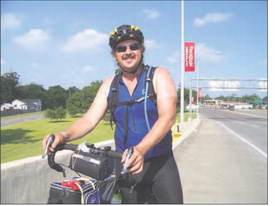
Hugh Holborn’s cross­country bike trip was prompt­ed by a death-cheating epi­sode.
His son Alex was driving his Volkswagen Jetta when both he and Holborn dozed off. Holborn was startled to find that the car was going straight toward a tree. He quickly took control of the wheel and avoided an accident.
That was a wake-up call.
“I felt as if I had been given a second chance,” says Holborn. “It had been a tough year. I had had to close my art gallery and had also begun to have health problems. I needed a major change to transform the energetic flow of my life.”
The major change involved riding more than 2,000 miles on a bicycle from St. Augustine, Fla., to Taos. It was a journey that star ted May 21 and ended July 20.
A 54-year-old web design­er and artist, Holborn doesn’t consider himself an athlete. Though he often rode his bike in town, he admittedly “prized comfort over exercise.” And yet, he decided to put every­thing on hold (his business, his life) and cycle to Taos.
Why Taos?
“I lived in this town for eight years and own a house here,” he explained.
He built the house in 1991 and has driven to and from St. Augustine many times. But he wanted to experience more of the country than what can be seen from a car at 70 mph.
“There is so much out there,” he said, “and we always pass by at the speed of light. We need to slow down.”
The need to slow down is the main concept behind his blog www. slowlifeonabike.com, where he documented the trip. Holborn has even coined a term — Time Deficit Syndrome— to describe the constant rush that prevailed in his life.
But it wasn’t just all ride and no work. Holborn traveled with his laptop and completed sev­eral projects on the road while his office manager took care of the business in Florida. He worked in libraries and coffee houses.
“McDonalds is a great resource to find Wi-Fi,” he said.
Holborn stayed in camp­grounds, churches and fire departments. “I would call the battalion chief and ask if I could camp behind the fire station. Usually, they let me use a bed, a shower and even fed me.”
He also found places to sleep through Warm Showers, an organization that suppor ts cyclists on the road.
He wanted to see the ocean all the way to New Orleans but when he began the tr ip, the oil spill had already star ted.
“I didn’t actually see the spill,” he said, “but felt the tenseness, the cloud of con­cern over the people and the entire place.”
What about personal safe­ty?
“My friends asked if I was taking a gun,” Holborn said. “I didn’t, because I did not want to attract that kind of energy. I had some pepper spray in case dogs chased me, but the only one that did was a big Chihuahua in Bayou La Batre.” His best experiences were about the discover y of human kindness to strangers. In Lee, Fla., he met law enforcement officer Dale Kinard, a guardian angel in uniform. His story is told in the blog post “Buddha at the Inspection Station,” where both men reflect about the meaning of life.
Though he traveled between 45 and 60 miles a day, pull­ing a trailer with 40 pounds of gear and carr ying another 40 pounds on his back, Holbor n acknowledges that the hard­est part of the trip wasn’t the physical effor t.
“The most difficult-to-con­trol space was that between my ears,” he said, laughing. “I kept imagining myself at work, taking care of the business, answering e-mail. It wasn’t easy to let go of all that.”
Holborn did accomplish the major change that was the whole idea behind the trip. He now relishes the sense of peace he got out of his journey. It allowed him to start moving at a slower pace.
“When you are pedaling, days are measured in a differ­ent way,” he says. “Your sense of time is altered and you get back to how it must have been when people crossed this country in carts and horses.”
“It was a spiritual journey,” he said, thoughtfully. “Cycling was just a method that taught me to slow down.”
He also lost around 15 pounds and his health has improved. “I retrieved myself,” he says. “I know I’ll be fine now.”
Holborn says that it has been difficult to get off the bike.
“It’s going to take a while to go back to reality.” He paused briefly. “Sometimes I feel I should continue pedaling.”


Nests of faith

 Originally published in The Taos News
 
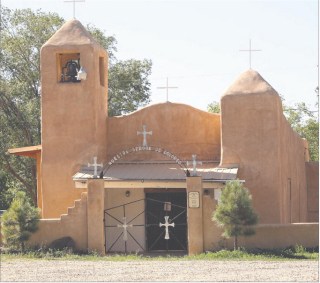
Nuestra Senora de Dolores, off Kit Carson Road in Taos
————————————————————-
 
Altar servent María Mondragón at
 Nuestra Señora de Dolores in Arroyo Hondo
——————————————————-
La Capilla de Nuestra Señora del Carmen,
 on Hot Springs Road in Llano Quemado.
Fotos by Tina Larkin
Chapels have kept alive the faith of Taose-o Catholics for more than two centuries. There are three parishes in Taos County: San Francisco de Asís, Our Lady of Guadalupe and San Antonio de Padua, and a number of small chapels known as capillas under their pastoral care. These capillas are symbols of long-standing popular devotion, as well as places of worship. And 200 years ago, they were essential features in the lives of the families and communities that built them.
The historic San Francisco de Asís church was finished in 1815, but the parishioners who lived in remote settlements (or at least distant enough to prevent them from going to church in the some­times harsh Northern New Mexico winters) also built their own chapels. It was the only way to make sure they would receive the visit of a priest and attend Mass on a regular basis. In such close­knit towns, the construction of a capilla was a community effort. Because of the extreme isola­tion of the region, statues of saints and cult objects couldn’t be easily imported from Mexico or Spain so the worshippers made everything themselves, from the building, generally an adobe house, to the bultos (wood-carved representation of saints) that decorated it. Three of these capillas now belong to the San Francisco de Asís parish in Ranchos de Taos.
The Llano Quemado chapel is dedicated to Our Lady of Mount Carmel (Nuestra Señora del Carmen), the one in Talpa to Nuestra Señora de San Juan de los Lagos (Our Lady of the Lakes) and the Los Cordovas capilla to San Isidro. Mass is cel­ebrated once a month in each of them by Father Francis Malley or, in his absence, Father William McNichols, the famous iconographer popularly known as Father Bill. The care and upkeep of the capillas is entrusted to four mayordomos who clean the building and make sure that it is ready for the services. Angela Valerio, the business manager at the San Francisco de As’s parish, served as may­ordomo for the Llano Quemado chapel in 2005 and 2006, with her two sisters and one brother-in-law.
“Nuestra Señora del Carmen is an old, old capil­la,” she says. “Each family used to build its own pew, so if you look at the older ones, you’ll notice that they are all different in size and shape. Now there are new pews, but families can still have one.
My father passed away in 2006 and we dedicated a pew to him.”
A beloved tradition is to keep a seven-day candle in the chapel, and it’s the mayordomos’ responsibility to make sure the candle is always lit. Mayordomos also participate in religious func­tions held in other chapels and in the parish. “You develop a special relationship with the chapel and those who attend mass there,” says Valerio.
Chapels can fit around eight people but nowa­days they are rarely jam-packed.
“There used to be more involvement from the community,” admits Valerio.
Still, the capillas are full of faithful in the feast day of their saint, when worshippers gather togeth­er for the vespers and the actual celebration, la función.
“We need to preserve our chapels,” she says.
“The capillas are part of Taos’ living traditions, a crossroads of history and faith.”

The charm is in the chile

 
 Originally published in The Taos News
 
When I asked Raquel Troyce, a native of Guadalajara who lived most of her adult life in Mexico City, if she knew anything about smothered burritos, she thought I was talking about some poor little donkeys that drowned. She was familiar with regular burritos (a flour tortilla folded around chicken, beef or beans), but had never heard of “smoth­ered” ones.
Regular burritos are mostly popular in the northern part of Mexico and it is said they originated in Ciudad Juarez, in the state of Chihuahua.
As for the “smothered” kind, they are an American creation. Maybe even a New Mexican one.
Orlando’s New Mexico Café, at 1114 Don Juan Valdez Lane in El Prado, is known for the quality of its food. It offers four kinds of smothered burritos: beef, chicken, vegetar­ian and shrimp. They are covered with chile (red, green or caribe), topped with jack and cheddar cheese.
Orlando’s walls are decorated with ris­tras, paintings by Barbara Brock and Berlin Padilla, and the numerous awards that the restaurant has gotten since it opened in 1996. A large, wood-carved image of San Pascual Bailòn, (patron saint of cooks) presides over the kitchen. There are also other santos that local artists have brought here to display.
Roberto Zabala, a young man from Guanajuato, Mexico, is one of five cooks currently employed by Orlando’s. He has pre­pared more than two dozen smothered burritos on the day of our visit.
“The New Mexico smothered burrito is unique,” he said, “And it’s the kind of chile we put on top that makes it different because it is so flavorful and fresh.”
Another cook, Patsy Vigil, a Taos native, agrees. “Our chile is handmade from scratch,” she said. “All the ingredients are cooked here, not canned or processed.”
Orlando himself came up with the green chile recipe. His grandmother, Delfina Archuleta, invented the one they use to make vegetarian red chile.
Orlando started his business selling handheld burritos (the regular kind, smaller than smothered ones and with no chile on top) from a cart in Cabot Plaza. When he opened the restaurant, he added smothered burritos, enchiladas, chile rellenos and the other delicious items now listed on the menu.
“I believe people like the smothered burritos better,” said Vigil. “They have the chile flavor, the hot taste.”
As for what makes a good smothered burrito, having the right texture for the tortilla is imperative.
“You have to warm it up before,” said Vigil. “Then, you put cheese, onion, beans, and cooked chicken, beef or shrimp inside it. Roll it up nicely and add a little bit of whatever chile you want to use, and cheese on top. Put it on the salamander broiler briefly and let the cheese melt.
Bring it out, pour more chile over the bur­rito and garnish it with lettuce and toma­toes, and beans and posole on the side.”
The burrito must also be wrapped up properly.
“Some people fold it up as if it were a tamale,” said Zabala, “No! A good smothered burrito should be presented like a work of art, nicely wrapped up and covered with a thin blanket of chile.”
I took Raquel to Orlando’s and showed her the menu. She chose the vegetarian smothered burrito, tasted it and smiled.
“I’m sold on it,” she said. “And I am relieved, too. A smoth­ered burrito doesn’t look at all like a donkey, dead or alive.”
‘A good smothered burrito should be presented like a work of art, nicely wrapped up and covered with a thin blanket of chile.’